 24/7 Customer
Support
24/7 Customer
Support Free Express Shipping 24/7 Customer
Support Free Express Shipping
Free Express Shipping 24/7 Customer
Support Free Express Shipping
Overview
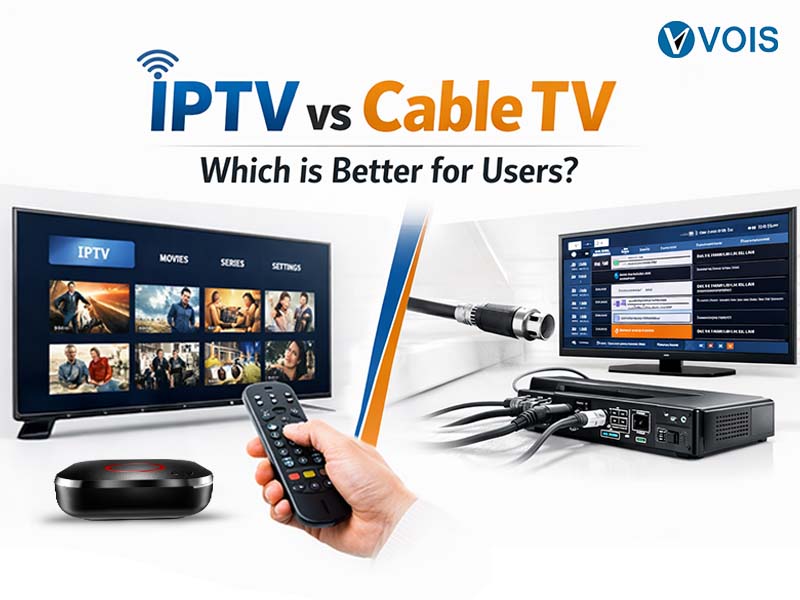
IPTV is more flexible, economical and diverse than traditional cable TV. IPTV Canada has emerged as a favorite among many viewers due to the emergence of streaming platforms and change in user preferences. It is time to explore the major differences between IPTV vs cable TV. While IPTV offers more flexibility, a wider range of content, and affordable pricing, cable TV remains a traditional option with fixed channel bundles and installation requirements.
TV has evolved a long way. We no longer have to carry the cumbersome set top boxes and antennas. Instead we can stream content on our smart devices. The shift towards IPTV (Internet Protocol Television) is one of the most dramatic changes in TV viewing.
So, what’s the difference? And which is more user friendly? We shall now have a more detailed look at the two alternatives – IPTV vs cable TV and analyze their advantages and disadvantages.
Experience smooth streaming with 15,000+ HD channels and a massive VOD library. No commitment, no payment required. Start your free trial today and see why Canadians trust Vois IPTV.
Start 72-Hour Free TrialIPTV is an abbreviation of Internet Protocol Television. It transmits television content online, unlike the conventional cable networks or satellites. Instead of watching content via satellite dish and coaxial cable, IPTV users stream their content in real-time.
Has a large selection of content: You will be able to stream movies, events, and TV shows.
On-demand streaming: Watch shows and films at your convenience.
Flexible: IPTV is compatible with numerous gadgets, such as smartphones, laptops, smart TVs, and tablets.
Usability: The users are able to access anything at any place provided they are connected to the internet.
Cable TV on the other hand is the conventional TV services that are provided by use of coaxial cables. The cable TV system offers a subscription to a fixed package of channels and requires the use of a cable box or a set-top box to access the content.
Fixed channel lineup: Here you are offered a fixed number of channels, where there are fewer choices on how to customize it.
Physical hardware requirements: You need a cable box or a satellite dish.
No internet connection needed: You can watch TV as long as cable connection is working.
The cost saving is one of the reasons why people switch to IPTV. Cable TV is more costly because of steep subscription charges, equipment rentals and the extra fee of premium channels.
Cable TV can be very costly with regards to monthly payment, particularly when you subscribe to a number of premium channels. Furthermore, cable television providers tend to force consumers into the long-term contracts. This makes cable TV extremely costly.
Extra fees: Cable television services have an extra charge on hardware, premium channels and installation charges.
| Aspect | IPTV | Cable TV |
|---|---|---|
| Content Variety and Customization | IPTV services are flexible and customizable. Users can select channels and content. | Limited customization. Channels are predetermined and cannot be easily changed. |
| Channel Choices | Incredible diversity across genres like movies, TV shows, and international programs. | You pay for a package, often including channels you won’t watch. |
| On-demand Content | Content available on-demand anytime. No need to follow a fixed schedule. | No extensive on-demand services. You only get live channels. |
| Device Compatibility | IPTV works across devices—phone, tablet, computer, and smart TV. | Works only with TV and set-top box. No flexibility to stream on other devices. |
| Multifunctionality | Stream on various devices like phone, tablet, laptop, or smart TV. | Restricted to TV viewing, limiting portability. |
| Flexible Viewing | Watch anywhere with an internet connection. | Can only be viewed on TV with a set-top box. |
| Picture and Audio Quality | HD, Full HD, and 4K depending on internet speed. Dynamic quality scaling based on bandwidth. | Generally standard or HD quality. Few providers offer 4K content. |
| Quality | HD and 4K available for better clarity and sharpness. | Standard or HD resolution is typical, limited options for higher quality. |
One of the strongest points about IPTV is the flexibility it provides. You are not restricted by broadcast schedules. You can also view your preferred shows and movies at your convenience with the help of an IPTV.
On-demand content: View programs anytime you like.
Catch-up TV: Many IPTV services offer catch-up TV which means you can view the episodes that you have missed.
Cable television has a predetermined schedule. On-demand shows are not easily viewed unless one subscribes to another service like DVR which may attract a fee.
Set Viewing Time: When you miss a show, you must wait till the show comes on air again.
DVR Features: You can record programs usually at additional cost and extra equipment.
The installation of IPTV is not very difficult. As all you need is an internet connection, you just need to subscribe to a service and install the application on your device. It does not require any professional installation.
Easy Installation: All you have to do is to get connected to the internet, get the app, and begin to stream.
Cable TV is more complicated to install. The required equipment such as the cable box and other hardware are often installed by a professional.
Long Setup Time: It can require hours to install, and technicians might have to make several visits.
A great number of IPTV services provide 24/7 customer care, which is a major strength. It is easy to contact them through chat, email or phone to solve problems.
Quick Response: The majority of services have 24/7 customer care.
Customer care with cable TV is not very responsive and fast. You might need to spend much time in queues when seeking assistance.
Delayed Support: At times, there are technological problems that require more time to solve.
Though IPTV may have a higher level of privacy over cable TV, users should exercise caution. Not all IPTV providers have good security systems, so it is necessary to use a reliable one.
Data Privacy: It is important to always use a trusted IPTV operator to avoid security threats.
Cable television does not depend on internet connection which is more susceptible to cyber attacks. Nevertheless, it is also able to gather user information to use in targeted advertisements.
When it comes to IPTV vs cable TV, IPTV is more flexible, cheaper and has a greater range of content than the traditional cable TV. IPTV is a better choice in case you are the kind of person who prefers to stream content on-demand, does not want to spend a lot of money on cable packages, and wants to watch television through multiple different gadgets. As it gains more popularity, IPTV Canada service is thus becoming more and more appealing to its users.
Although cable TV is stable, it is losing its relevance in the digital world. The future lies in IPTV, which has a much more individualistic and affordable viewing experience.
VOIS IPTV is a good alternative to cable TV in case you are seeking a more favorable alternative. It has access to more than 15000 live channels and an enormous content of 500000+ VOD. You have smooth streaming, and quality performance. The support is 24/7 and hence there is always help when it is required. The platform also offers convenient features to enhance your viewing experience. To top it all, the IPTV plans are easy and affordable.
Experience smooth streaming with 15,000+ HD channels and a massive VOD library. No commitment, no payment required. Start your free trial today and see why Canadians trust Vois IPTV.
Start 72-Hour Free TrialIPTV gives greater flexibility and on-demand services. Cable TV involves the use of cable box and offers fixed channels.
IPTV tends to be less expensive than cable television. IPTV charges you only for what you consume unlike cable TV that has hidden charges and equipment costs.
Yes, IPTV is compatible with smartphones, laptops, smart TVs, and others, provided that you have access to the internet.
Yes, IPTV supports HD and 4K resolution, provided your internet speed is high enough.
Yes, the majority of IPTV services give you the opportunity to cancel any time without any charges.
It is not illegal provided that you are subscribing to a legal IPTV service. Subscribe only to legal IPTV providers.
