 24/7 Customer
Support
24/7 Customer
Support Free Express Shipping 24/7 Customer
Support Free Express Shipping
Free Express Shipping 24/7 Customer
Support Free Express Shipping
TLDR;
IPTV provides access to live TV as well as on-demand services using specialized TV networks, which offer reliability as well as improved quality. OTT services give access to on-demand services using the internet, which offer flexibility as well as cost-effectiveness but might be prone to variations depending upon the internet speed. IPTV service in Canada allow users to watch regional TV along with more reliable services.
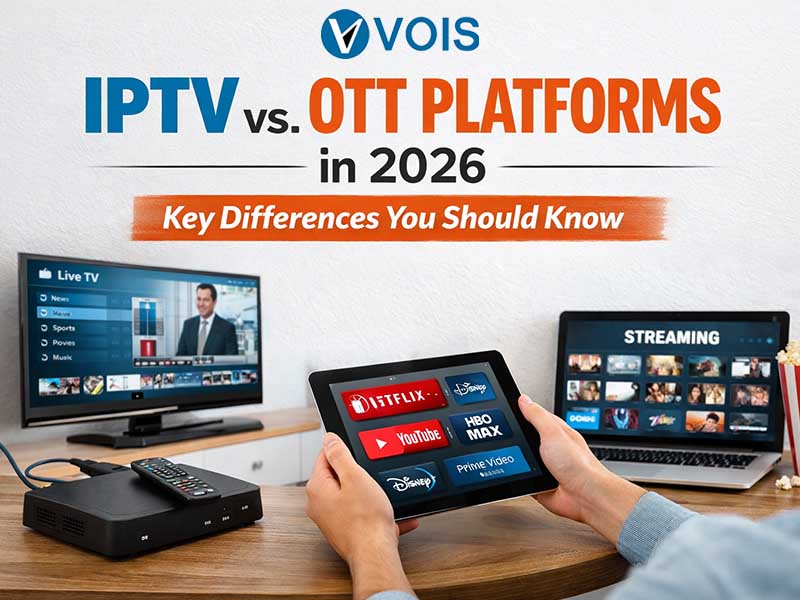
With the ever-changing digital entertainment industry, Internet Protocol Television, or IPTV, and Over-the-Top, or OTT, have been at the forefront of the new revolution in television consumption. Even though both IPTV and OTT have gained popularity as the new means through which people watch their television, the two have some distinctions. To get the best service, it is important to get a comprehension of IPTV vs. OTT platforms.
Within this blog, we’ll take a closer look at the differences between IPTV and OTT services, as they relate to the application of OTT technology in the context of IPTV service in Canada.
IPTV is an abbreviation for Internet Protocol Television. IPTV is a service for watching television online using Internet Protocol television. It doesn’t use the radio frequencies and satellite transmission method of the traditional satellite and cable TVs. This is because IPTV makes use of the fast connection of the internet for the transmission of high definition images and sounds. This provides the viewer with a personalized viewing service.
IPTV is mostly offered by internet service providers or IPTV providers. The IPTV is accessed by viewers utilizing set-top boxes or suitable devices including smart TVs and Android boxes, among others.
OTT: It is known as over-the-top, meaning that it does not require the infrastructure of cable TV. OTT requires the viewing to go through the internet. This reduces the costs of viewing significantly, as it uses the infrastructure of the internet. Here, the user requires an internet connection, and the content can be viewed through smartphones, tablets, computers, and other devices.
Services like Netflix, Amazon Prime Video, Disney+, or YouTube would be examples of OTT Platforms. They do not depend on any broadband or set-top box at all; hence, the flexibility level of OTT Platforms is high.
Though IPTV and OTT are both services that deliver online contents, they serve different types of viewers in terms of watching experiences. Below are the key differences in IPTV vs. OTT platforms:
1. Content delivery method
IPTV
It transmits the content on an internal, dedicated network, which could be the service provider’s network, ensuring the viewer gets an ideal viewing experience. It is more reliable compared to the other service.
OTT
Sends content over the open internet, which means the network is uncontrolled by the internet service provider. This means the delivery of content largely depends on the speed of the internet provided by the user’s internet connection. This may cause buffering in cases where internet usage is high.
2. Content Access and Licensing
IPTV
Provides live television channels, video-on-demand content, and occasionally pay-per-view services based on subscription models. IPTV operators usually package a selection of channels within a bundle package. IPTV services sometimes offer local as well as international content channels.
OTT
Provides on-demand content such as movies, TV programs, as well as original content. The content is primarily pre-created, enabling users to access it at any time and from anywhere, without having to comply with a TV schedule. OTT platforms like Netflix, Disney+, among others, have a great collection of content accessible at a certain cost per month.
3. Content Availability and Flexibility
IPTV
In this case, the content is usually determined by the IPTV provider and lacks the same flexibility in terms of viewers choosing the programs that interest them beyond the set bundles of content. In most cases, the IPTV is utilized in a more traditional channel-based manner, just like the conventional satellite and cable TV.
OTT
The OTT platform provides a lot of flexibility, and consumers can choose the programs they wish to watch. The OTT platform provides consumers with total control over their program selection. The OTT platform is very useful for binge watchers and people who watch programs according to their own convenience.
4. Quality of Service & Stability
IPTV
Since IPTV has a dependency on a broadband network, it usually provides a more stable connection as far as video quality is concerned. This will be more beneficial when it comes to watching live TV or sports programs, where a buffering process might be a deterrent to the end-user.
OTT
The service quality can also differ depending on internet speed and stability. Though many of these OTT platforms support 4K and HD, this does not always make for a smooth viewing experience, especially when the user’s internet connectivity is poor or irregular. Such problems can cause buffer starts and poor video quality, especially during peak hours.
5. Cost
IPTV
The subscription fee for the IPTV services tends to be high compared to other forms of television services owing to the complexities involved in delivering the services. Some of the IPTV service providers offer packages such as internet, television, and telephones. The rates are charged by the service providers on a yearly and monthly subscription basis.
OTT
OTT platforms are relatively more economical, with different pricing strategies ranging from free (ad-supported) to premium. It is likely that OTT platforms would work out to be cost-effective compared to IPTV platforms, which require less investment in infrastructure, licensing, or other costs. Still, consumers have to subscribe to multiple services to get access to their favorite content.
6. User Interface and Experience
IPTV
The user interface for IPTV platforms is generally more conventional, recreating the viewing experience of traditional cable and satellite television. The viewer can change channels and view on-demand content using a TV app on a smart TV set-top box.
OTT
OTT services usually have a more contemporary and interactive user interface that includes functionalities such as content recommendation, search, and recommendation services. The OTT platform gives utmost importance to the user interface and design and comes up with simple and eye-catchy interfaces on all devices.
7. Legality & Compliance
IPTV
IPTV is legal and does not violate broadcasting legislation, especially if it is acquired from legal IPTV service providers. In countries such as Canada, where IPTV is somehow governed, it is vital to engage a licensed IPTV service provider who is bound by government guidelines.
OTT
OTT platforms such as Netflix and Amazon Prime Video are fully legal and accepted by society at large. However, consumers must ensure that their subscription is from a genuine OTT provider with a proper license to avoid any trouble with pirated content.
Experience smooth streaming with 15,000+ HD channels and a massive VOD library. No commitment, no payment required. Start your free trial today and see why Canadians trust Vois IPTV.
Start 72-Hour Free TrialIn the case of IPTV in Canada, there are a few important concepts that must be understood. The Canadian government controls the television broadcast industry, and therefore the IPTV industry must subscribe to certain licensing and content regulations.
Though a number of OTT platforms are available in Canada, they contain very limited programming targeting Canadian viewers. However, when it comes to IPTV platforms, they are able to offer programming from both within and outside of Canada, ensuring a complete viewing experience. If you are looking to access local news networks and sports networks that contain events, IPTV available in Canada could be right for you.
There are also IPTV providers offering packages including several channels such as sports channels and international news networks. This provides the viewer with several options beyond what is generally available using OTT.
The choice of whether to go for IPTV or OTT services depends on your viewing preference and your internet connection capability. You may prefer to go for the IPTV service since you prefer watching live TV and want high-quality viewing, as well as the ability to watch Canadian TV channels. Alternatively, you may want to watch TV programs, and OTT services like Netflix and Disney+ will allow you to view more TV programs compared to other TV services at a lower price.
Both have their own advantages, but they tend to serve differing audiences. TV in the future is changing, and knowing the differences between the two technologies of IPTV vs. OTT platforms will assist in selecting the right service according to your needs.
What is the biggest difference between IPTV vs. OTT platforms?
IPTV broadcasts content through a private network with a high degree of stability and quality, especially while watching live TV. On the other hand, an OTT broadcasts through the internet with on-demand content such as Netflix, depending on the speed of your internet connection.
Is it possible for me to view Canadian stations using IPTV?
Absolutely! IPTV service in Canada delivers a lineup of local programming through Canadian channels as well as international programming, making it a good option for anyone looking for access to real-time television programming such as news, sports, and other programming specific to a certain region or city.
Which service has greater flexibility? IPTV vs. OTT platforms?
OTT platforms have flexibility as they enable viewers to watch any program at any time and from any location. With IPTV, flexibility and freedom over viewing any program at any particular time are limited since the services mainly offer live TV programs.
Is IPTV more reliable than OTT?
Yes, IPTV is definitely more reliable because of the use of dedicated networks. With OTT, it is dependent on the quality of your Internet connection. Therefore, a lot of people may have experienced buffering when streaming online.
Are there any disadvantages with IPTV?
However, the drawback associated with IPTV may include the need for a set-top box in order for it to function in addition to accessing specific services. It might also lack the level of on-demand content compared to OTT technologies such as Netflix or Hulu.
How Much Does IPTV Cost in Canada?
In Canada, the price of IPTV is dependent on the firm that is offering the service as well as the package that you require. Normally, you would need to pay a certain amount of money to access the services, though in some instances you could get access to internet and TV services depending on the provider that you select.
