 24/7 Customer
Support
24/7 Customer
Support Free Express Shipping 24/7 Customer
Support Free Express Shipping
Free Express Shipping 24/7 Customer
Support Free Express Shipping
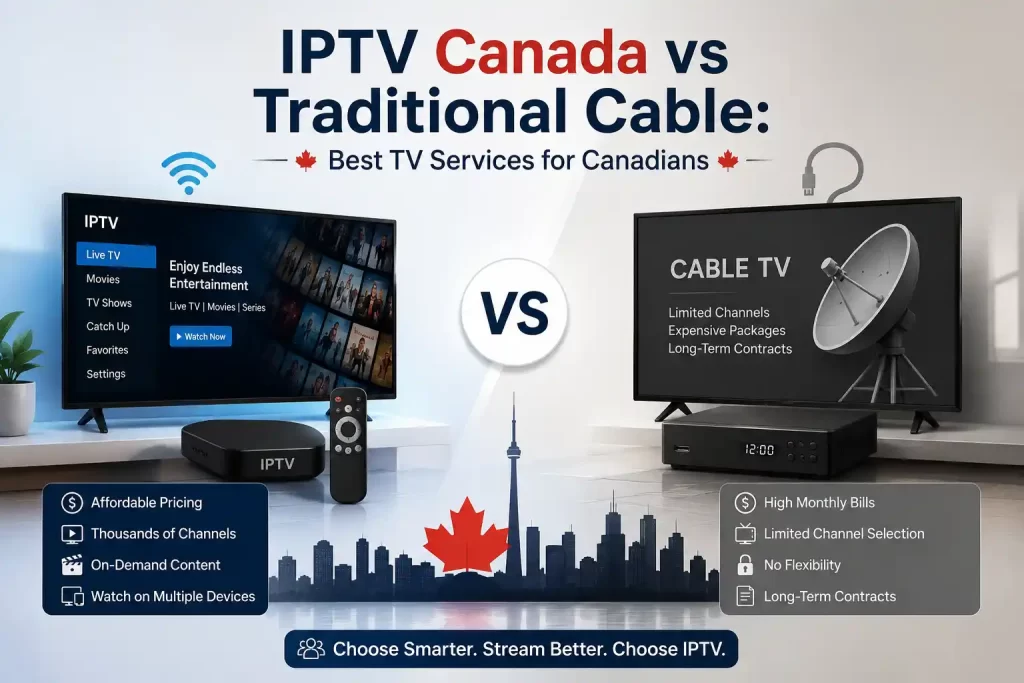
Cable TV subscriptions have steadily declined throughout Canada over the past decade, and the IPTV Canada vs Traditional Cable debate reflects this shift. For those that have re-subscribed in the recent past, they can undoubtedly attest that the value proposition of traditional cable has gone down. Not only has the rate gone up, but the channel offerings remain stagnant, while half of the lineup is rarely watched—making IPTV Canada vs Traditional Cable an increasingly one-sided comparison in favour of IPTV.
IPTV Canada has carved out a niche for itself, and what began as a convenience for early adopters has grown into a full-fledged competitor for traditional cable TV. While having access to more channels, lower rates, and flexible payment plans sound ideal, the practicality for most Canadian families is still in question.
Here will review the differences between IPTV service and traditional cable. From a price-per-channel and range of content perspective, to the day-to-day performance and reliability of the service. Everything has been weighed out so that families can make the most informed decision based on their needs.
Still comparing IPTV Canada and traditional cable? Test the experience yourself with a free trial. Explore live channels, on-demand content, streaming quality, and device compatibility before making any commitment.
IPTV stands for Internet Protocol Television, and it essentially transports channels and content over the internet to whichever display device is being used. Unlike traditional cable, which uses satellite and coaxial cabling, IPTV Canada utilizes the consumer’s existing home internet connection to deliver similar content.
There are several reasons why this type of television service has become so popular in such a short time:
Traditional cable TV has long been the staple home entertainment system for millions of Canadian households. Providers such as Bell, Rogers, and Shaw have historically captured a large chunk of the market by bundling television, internet, and phone services together under one bill.
Unlike IPTV service, traditional cable requires physical coaxial cabling to be run to whichever television set is being used. This has resulted in higher rates for Canadians, due to the capital expenditures necessary on the provider’s end.
Where traditional cable excels is in its reliability. It is mostly impervious to the day-to-day fluctuations of the home broadband connection, which is a huge advantage in rural areas.
Experience smooth streaming with 15,000+ HD channels and a massive VOD library. No commitment, no payment required. Start your free trial today and see why Canadians trust Vois IPTV.
Start 72-Hour Free TrialAs expected, price is the primary deciding factor for most families, and it is the main reason why so many have switched to IPTV Canada in recent years.
| Feature | IPTV Service | Traditional Cable |
| Average monthly cost | $15–$30 CAD | $70–$150+ CAD |
| Installation fee | None | Often $50–$100 |
| Contract requirement | Usually none | Often 12–24 months |
| Equipment rental | Not required (existing device works) | Set-top box rental fees apply |
| Channel count | 5,000+ channels typical | 200–500 channels typical |
| International channels | Extensive | Limited or costly add-ons |
| Trial availability | IPTV free trial commonly offered | Rarely offered |
The sheer value of what IPTV Canada offers over traditional cable has prompted many to switch, especially renters who are unable to make long-term financial commitments.
The biggest problem with traditional cable providers is that there is a limited number of channels they provide. Families that want more access to desirable channels must pay more or opt for expensive packages. IPTV Canada usually offers more channels for less, as it acquires channels from a wide range of international broadcasters.
Sports programming continues to be one of the strongest draws for IPTV Canada subscriptions. Additional costs for sports channels or packages are typically unnecessary, as most providers bundle them into their standard subscriptions. IPTV Canada also offers more desirable on-demand content with frequent updates.
IPTV Canada was one of the first to recognize the diverse nature of the Canadian landscape and the diverse ethnic makeup of the country. Traditional cable providers do not carry as diverse a programming schedule, and the ones that do charge much more for the privilege.
Traditional cable has a significant advantage over IPTV Canada when it comes to sheer performance and reliability. As it uses physical coaxial cabling rather than the home broadband connection, it is not as susceptible to outages or performance degradation.
This is the main reason why traditional cable still dominates in rural areas, whereas IPTV Canada is usually limited to metropolitan regions with higher broadband penetration. Several factors can cause IPTV performance issues, including:
Canadian households with subpar broadband or an older router may find that traditional cable is a more reliable option.
Traditional cable providers usually require that you sign a contract for 12 to 24 months. If you wish to cancel the service before that time is up, you will be charged a king’s ransom. After the first year, promotional rates for traditional cable companies expire, and the rates skyrocket. Subscribers usually end up paying anywhere between 20% to 40% more after the promotional period expires.
As mentioned previously, IPTV Canada is considerably more flexible, as it allows customers to test out the service on a month-to-month basis. This means that:
Most Canadians who are fed up with traditional cable providers turn to IPTV Canada precisely because of its flexible payment plans.
Setting up traditional cable TV usually involves scheduling an installation appointment with the local provider. Not only is this a time-consuming endeavor, but it also involves renting a set-top box from the provider and running coaxial cabling through the home. In some cases, especially rentals, consumers may even end up paying additional fees to install the system.
The setup for IPTV Canada is much easier since the only equipment required is:
Essentially, any device with internet access and a screen can be used to access IPTV Canada. The setup is also much more straightforward and only takes a matter of minutes, as it only requires downloading the IPTV app and entering the subscription credentials.
The truth is that not all IPTV providers are created equal, so it is best to do a little homework before investing in an IPTV subscription. The IPTV providers that operate legally either own the content that they provide or operate from countries that do not hold them to the same legal standards as traditional cable companies.
When choosing an IPTV provider, make sure that:
Vois IPTV is one of the most popular IPTV providers among Canadian users because it offers great value for money and a generous free trial period.
It boils down to value; your budget versus your expectations.
Choose an IPTV Subscription if:
Traditional Cable is for those who
Get access to thousands of channels, international content, flexible plans, and IPTV box support with Vois IPTV. Enjoy more entertainment while spending less every month.
For the majority of Canadian households that are already set to pay for an Internet service, IPTV Canada is just a better deal. It provides more channels for a significantly lower price with no contract required, while cable services are more relevant for those with no access to high-speed Internet, such as those living in remote areas, and those that are not willing to use any streaming service.
However, instead of basing the choice solely on the arguments made by either side, it is rational to consider an option of a IPTV free trial and conduct some research to determine which of the two is indeed a better choice in a specific situation.
By comparing the list of available channels and other features of a cable service provider in the area, one will be able to arrive at a more informed conclusion and decide based on actual experience rather than marketing.
