 24/7 Customer
Support
24/7 Customer
Support Free Express Shipping 24/7 Customer
Support Free Express Shipping
Free Express Shipping 24/7 Customer
Support Free Express Shipping
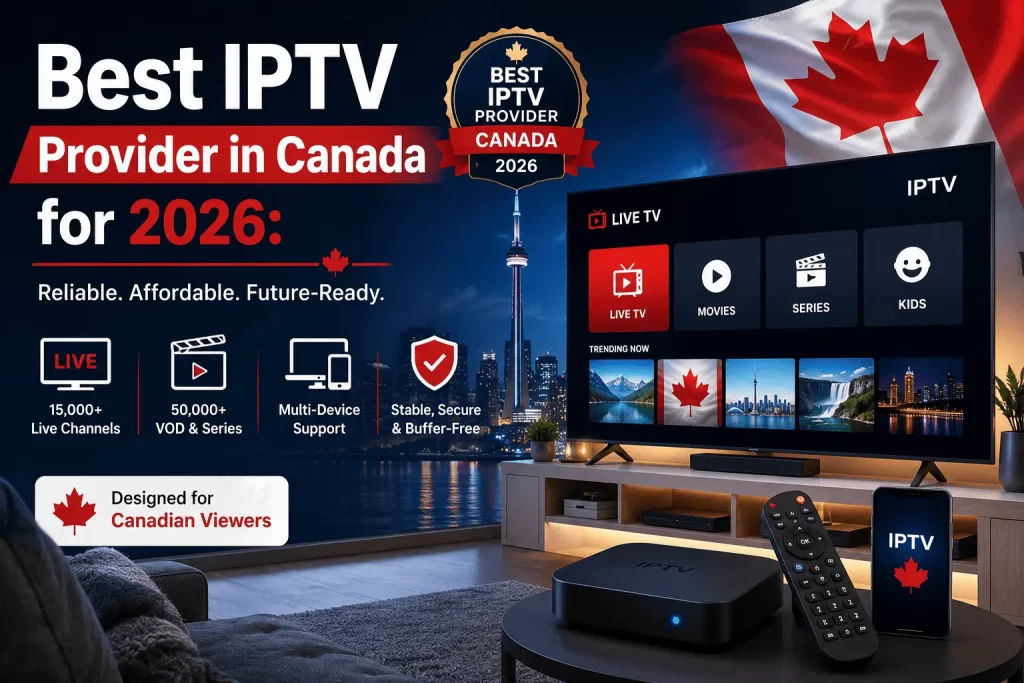
best IPTV provider 2026″ into Google and you’ll get a dozen listicles recommending the same five brands, usually with zero explanation of why. Not much help if you’ve already burned money on a service that froze every time the game got interesting. This guide is meant to actually be useful: what IPTV is, how it works, what separates a provider worth paying for from one that isn’t, and what Canadian households specifically should check before subscribing.
If you’re searching for the best IPTV provider Canada users can rely on, understanding channel quality, streaming stability, device compatibility, and customer support is just as important as the price. We’ll also talk about Vois IPTV toward the end, since it’s a name that keeps coming up for Canadian households, particularly Punjabi and Hindi-speaking families, looking for local and international channels in one place.
Experience premium entertainment with Vois IPTV. Start with a free trial or explore our flexible IPTV plans today.
IPTV stands for Internet Protocol Television. Rather than pulling channels off a satellite dish or a coaxial cable line, it delivers live TV, on-demand movies and shows through your internet connection. You watch through an app, on a streaming box, Smart TV, phone or laptop, and there’s no set-top box tied to a cable company sitting under your TV. Your TV signal is basically travelling the same route a Netflix episode does now, just over the internet instead of a dedicated cable network.
Cord-cutting stopped being a trend a while ago; it’s just what people do now. Cable bills keep going up, contracts lock you in, and most households genuinely watch maybe 15 channels out of the 200 they’re paying for. IPTV gets rid of most of that friction. Bigger channel libraries, no two-year contract, and it works across whatever devices you already own. Between faster home internet and better compression tech, IPTV has quietly become the more practical option for a lot of Canadian households, not just the tech-savvy ones.
| Feature | Traditional Cable | IPTV |
| Installation | Technician visit, wiring | Download an app, log in |
| Contracts | Often 1-2 year lock-in | Usually month-to-month |
| Pricing | $80-$150+/month | Typically far lower |
| Channel Selection | Fixed regional bundle | Thousands of channels worldwide |
| Device Flexibility | One cable box per TV | Works on phones, Smart TVs, Firestick, tablets |
| International Channels | Limited add-on packages | Wide selection often included |
| Cancellation | Can involve fees | Cancel anytime, no penalty |
An IPTV provider hosts channels and on-demand content on its servers, then streams it to your device over your internet connection through an app or player. Press play, your device asks the server for the stream, the server sends it back in small data packets, and the app turns that into the video you’re watching. No satellite dish, no cable box, no technician drilling holes in your wall. You just need a decent internet connection, and 15-25 Mbps is generally enough for smooth HD and 4K playback.
● Cord-cutters tired of paying for channels they never watch
● Punjabi, Hindi, Tamil, Telugu, and other South Asian households who want channels from home
● Sports fans following a league their local cable package doesn’t carry
● Renters who move often and don’t want to deal with cable installation every time
● Anyone comparing what they pay for cable against what they’d actually use
● Households that want to watch on the TV, a phone, and a tablet without extra hardware
“All IPTV is illegal” is probably the most repeated one, and it’s just not accurate — IPTV is a delivery method, the same one telecom companies use for their own TV apps. What actually matters is whether a provider has the rights to the content it’s streaming. “It’s too technical for regular people” is another one that doesn’t hold up; setup is usually download the app, log in, done, no different from setting up Netflix. And the idea that IPTV always looks worse than cable isn’t true either — picture quality comes down to the provider’s servers, not the technology itself.
It depends on the provider, not the technology. IPTV streaming protocols are used legally by major telecom and broadcast companies all over the world, so the tech itself isn’t the issue. What matters is whether a specific service actually has the rights to the channels and content it’s distributing. Practically speaking, that means choosing providers who are upfront about what they offer, steering clear of services making unrealistic promises, and treating pricing that seems too good to be true as something worth looking into before you hand over your card.
● Your internet speed — a shaky connection ruins even a great provider
● Whether the provider actually supports your specific device
● Whether there’s a free trial, and whether you’ve actually used it
● The refund policy, read properly and not just skimmed
● How fast support answers a question you send before you’ve even paid
Picking a provider shouldn’t come down to whichever ad you saw first on Instagram. It comes down to a handful of things that actually affect what you experience on your couch every night.
Plenty of providers slap “4K” on their homepage without the servers to back it up. Real quality comes down to how well a provider compresses and delivers video, and that’s tied directly to the infrastructure behind it, not a label.
This is usually the difference between watching the whole match and staring at a spinning wheel right when it matters. Providers running multiple backup servers with real anti-buffering measures hold up far better once everyone’s watching at 8pm.
Support quality matters more than most people expect until they actually need it. For diaspora households, being able to troubleshoot in Punjabi or Hindi instead of fighting through a language barrier makes a real difference.
Make sure the provider actually works on what your household owns: Firestick, Android boxes, Smart TVs, MAG devices, Windows, iPhone, Android phones, tablets. A provider that only covers one or two device types is going to frustrate someone in the house.
A decent lineup needs live channels, a real on-demand library, sports, and international content. If Canadian, US, UK, Indian, Punjabi, or French channels matter to your household, check that the provider spells them out clearly instead of vaguely promising “international channels.”
The closest thing you’ll get to a test drive. Use it properly, check quality during peak hours, not just at 2am when the servers are quiet.
Compare it to what you’re paying for cable now, but don’t just chase the cheapest listing. Check that there’s an actual refund policy in writing in case the service doesn’t play nice with your setup.
Apps that get updated regularly tend to run smoother and keep working as your TV or phone’s OS updates. If a provider’s app hasn’t been touched in months, that’s usually a sign of corners being cut elsewhere too.
Setup should take you a few minutes, not an evening. If the instructions are confusing before you’ve even started watching, that’s a preview of what support will be like later.
● Going with whatever’s cheapest without checking real reviews first
● Skipping the free trial entirely and just buying blind
● Not double-checking their exact device is actually supported
● Only reading the refund policy after something’s already gone wrong
● Not testing how support responds before they’ve paid a cent
● Is there a free trial, and can I use it before paying?
● Which devices are officially supported?
● How many connections come with one subscription?
● What’s the refund policy if this doesn’t work out for me?
● Do they carry the specific regional or language channels I actually want?
● If something breaks, how do I actually reach support?
Don’t decide based only on promises. Start your Vois IPTV Free Trial and experience the streaming quality yourself with smooth playback, HD & 4K support, and access to premium entertainment before choosing your IPTV plan.
🎁 Start Your Free Trial| Category | Average Provider | Great Provider |
| Streaming Quality | Inconsistent, frequent buffering | Stable HD/FHD/4K |
| Server Infrastructure | Single server, no backup | Multiple servers, load balancing |
| Support | Slow or no response | Fast, multilingual support |
| Trial | No trial offered | Free trial available |
| Pricing Transparency | Hidden fees | Clear plans and pricing |
| Device Support | Limited devices | Android, Firestick, Smart TV, MAG, Windows, iOS |
| Checklist Item | Why It Matters |
| Free trial available | Test before you pay |
| Device compatibility confirmed | Avoid buying something you can’t use |
| Clear pricing and refund policy | No surprise charges |
| Responsive customer support | Faster fixes when issues come up |
| Channel lineup matches your needs | Sports, movies, international content |
| Positive, verifiable reviews | Real user experience, not just marketing |
Out of the many IPTV options floating around, Vois IPTV has built its name on the two things this whole guide keeps circling back to: stability and channel variety. Households in Calgary, Surrey, Edmonton, Brampton, Toronto, and Montreal keep picking it for a fairly simple reason, it covers standard North American viewing and the regional, language-specific channels that a lot of bigger, generic providers just don’t bother prioritizing. For Punjabi, Hindi, Tamil, Telugu, Malayalam, Gujarati, Bangla, Marathi, and Nepali-speaking households, having all of that alongside Canadian, US, and UK content in one subscription fills a gap that’s genuinely hard to find elsewhere.
| Feature | Details |
| Live Channels | 15,000+ |
| Movies & TV Shows | 50,000+ on demand |
| Video Quality | HD, Full HD & 4K |
| Devices Supported | Android, Firestick, Smart TV, MAG, Windows, iPhone, Android Phone, Tablet |
| Regional Coverage | Canadian, US, UK, Indian, Punjabi, French channels |
| Setup | Fast activation, easy installation |
| Trial | Free Trial available |
| Support | Ongoing customer support |
| Reason | Why It Matters |
| Stable servers with anti-buffering technology | Fewer interruptions during peak hours |
| Wide regional and language coverage | One subscription covers the whole household |
| Broad device compatibility | Works across the devices you already own |
| Free trial before purchase | Test quality risk-free |
| Affordable, transparent pricing | No hidden surprises on your bill |
Explore Vois IPTV Plans and choose the package that matches your streaming needs — from simple single-device viewing to complete family entertainment bundles with premium channels and flexible options.
View IPTV Plans →Honestly, there’s no single answer that works for everyone, it depends on what your household actually watches, how many devices you’re covering, and which regional channels you care about. What’s fair to say is this: a provider earns your money when it delivers stable streaming, real device support, honest pricing, and support that actually picks up. For Canadian households wanting a solid mix of North American and South Asian regional content, Vois IPTV holds up on all of that, which is why it keeps getting mentioned in this space. Still, the smartest move is trying it yourself through a free trial rather than taking any one article’s word for it.
Stop guessing and discover a smarter way to stream. Explore Vois IPTV and enjoy reliable entertainment with live channels, movies, and premium streaming quality. Visit our homepage or start with a free trial today.
IPTV, short for Internet Protocol Television, delivers live channels and on-demand content over your internet connection instead of a satellite dish or cable line. You’d watch through an app on a streaming device, Smart TV, phone, or computer, rather than a dedicated cable box.
The real-world difference comes down to flexibility: a bigger channel library, support across multiple device types, and no long-term contract or in-home installation needed. Regular cable ties you to a fixed regional bundle and whatever hardware your cable company hands you, with far less room to add international or niche channels.
IPTV is a streaming technology, and it’s used legally by major telecom and broadcast companies worldwide, so the format itself isn’t the concern. What matters legally is whether a specific provider actually has the rights to distribute the content it streams.
As a rule of thumb, stick with providers who are upfront about what they offer, and be wary of services making unrealistic promises or pricing that seems oddly low compared to everyone else. Checking independent reviews before subscribing to an unfamiliar provider is generally a smart move.
Around 15-25 Mbps is usually enough for smooth standard and HD streaming on a single device. If you’re planning to stream 4K or run several devices at once, aim closer to 40-50 Mbps so nothing starts buffering during peak hours.
Wired connections tend to hold up better than Wi-Fi, especially for 4K, so plugging your streaming device into the router with an ethernet cable can fix a surprising number of buffering complaints.
In most cases, yes. Vois IPTV and other reputable providers support Firestick, Android boxes, Smart TVs, MAG devices, Windows, iPhones, Android phones, and tablets.
Setup is usually download the app or a compatible player, log in with your credentials, and start watching. It’s still worth confirming your exact device model before subscribing anywhere, since compatibility can vary a little between older and newer TV operating systems.
Coverage varies a lot between providers, even though most claim to offer “international channels” somewhere on their homepage. Vois IPTV specifically includes Punjabi, Hindi, and other South Asian language channels alongside standard Canadian, US, UK, and French content, which is a big part of why it’s popular with diaspora households across Canada. If this matters to you, it’s worth checking a provider’s actual channel list, or testing it during a free trial, rather than taking a homepage claim at face value.
Pricing varies by provider and plan length, but it tends to work out significantly cheaper than a comparable cable package once you factor in the larger channel count and the lack of a contract. Most reliable providers offer monthly plans alongside longer commitments that work out cheaper per month.
Rather than chasing whatever’s cheapest, it’s worth weighing price against server stability and support quality, since an unreliable bargain service usually ends up costing more in frustration than it ever saved in dollars.
Occasional buffering usually traces back to your internet connection, your device, or the provider’s server load. Start by checking your speed and switching from Wi-Fi to a wired connection if that’s an option.
If it keeps happening across different devices or times of day, that’s more likely a server-side problem, and this is exactly where provider quality shows up. Services running multiple backup servers with real anti-buffering measures tend to handle peak-hour traffic far better than ones running on thin infrastructure.
Many established providers, Vois IPTV included, offer a free trial so you can check streaming quality, channel availability, and device compatibility before spending anything. It’s genuinely one of the more useful things you can do as a buyer, since you get to judge the real experience rather than relying on marketing copy or reviews written by strangers. If a provider doesn’t offer any kind of trial or short test window, that alone is worth looking into before you subscribe.
That depends entirely on the plan, so it’s worth asking before you buy rather than after. Some plans cap you at a single active connection, while others allow multiple simultaneous streams across different devices in the same household. If your house has a Smart TV running in the living room and a tablet going in another room at the same time, make sure the plan you’re picking actually supports that setup.
It combines the fundamentals that actually matter, stable servers, wide device support, and a genuinely large channel library, with regional and language coverage built specifically for Canadian households, including Punjabi, Hindi, Tamil, Telugu, Malayalam, Gujarati, Bangla, Marathi, and Nepali-speaking communities.
That mix of technical reliability and audience-specific content is a big reason it keeps coming up when Canadian streamers compare IPTV services in 2026, on top of straightforward pricing and a free trial you can actually test before committing.
